
Real Care.
Real Clarity.
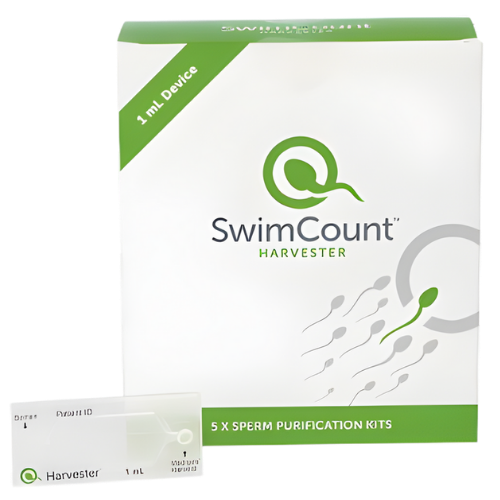
SwimCount™ Harvester 1 mL
For IVF & ICSI
Precise selection of high-quality sperm cells for assisted reproduction
The SwimCount™️ Harvester 1 mL is an advanced sperm purification device designed to efficiently isolate progressive motile sperm cells (PMSCs) with minimal manual handling. Utilizing innovative filtration technology that mimics natural selection processes, the device ensures the highest-quality sperm cells for IVF and ICSI procedures.
SPECIFICATIONS AND BENEFITS:

Capacity: Optimized to handle up to 1 mL of semen, making it ideal for smaller sample volumes.
Advanced technology: Reduces DNA fragmentation and oxidative stress, preserving sperm quality.
Minimal handling: Gentle process ensures maximum cell integrity and quality.
Applications: Designed for clinical use in assisted reproduction treatments.
The SwimCount™️ Harvester 1 mL delivers reliable performance and is compatible with standard incubation and harvest protocols. It ensures efficient workflows and enhances the overall success of fertility treatments.
SwimCount™ Harvester 3 mL
For IUI
Efficient processing of larger semen samples for IUI procedures
The SwimCount™️ Harvester 3 mL is specifically designed for handling larger semen sample volumes, ideal for intrauterine insemination (IUI). Its innovative technology ensures the selection of high-quality progressive motile sperm cells (PMSCs) while minimizing handling to preserve cell integrity and functionality.

SPECIFICATIONS AND BENEFITS:
Capacity: Optimized to process up to 3 mL of semen.
Advanced filtration: Ensures only high-quality PMSCs are selected, with low DNA fragmentation, improving treatment outcomes.
Minimized handling: Gentle processing protects sperm integrity and motility.
Applications: Designed to support IUI procedures in clinical fertility treatments.
The SwimCount™️ Harvester 3 mL simplifies IUI preparation workflows, ensuring consistent and reliable results. With its capacity for high-volume samples, this device supports clinics in delivering optimal outcomes for ART.
SwimCount™ Sperm Quality Test
Test your sperm quality with SwimCount™️.
SwimCount™️ Sperm Quality Test measures the number of the strongest progressive motile sperm cells (PMSCs) per mL, the only sperm cells capable of reaching and fertilizing an egg.

SPECIFICATIONS AND BENEFITS:
Easy and quick home test, instead of a visit to the doctor.
With an outstanding accuracy of 96%, validated against the WHO GOLD Standard (2010).
Provides sperm quality results in just 30 minutes.
The box contains one SwimCount™️ Test, one collection cup, one syringe for transferring the sample from the cup to the test, and one Instructions for Use leaflet.
The SwimCount™️ Sperm Quality Test is NOT to be used to determine the success of a vasectomy.
Piezoelectric Activation Device
An Innovative Method for Embryo Activation After ICSI
Piezoelectric activation technology is designed to support oocyte activation, particularly after intracytoplasmic sperm injection (ICSI), during in vitro fertilization (IVF).
SPECIFICATIONS AND BENEFITS:
Increased Oocyte Activation: Piezoelectric activation applied after ICSI can support early embryo development, potentially improving success rates. Clinical studies show that piezoelectric activation can significantly enhance fertilization rates in patients with oocyte activation deficiencies.
A Process Closer to Physiological Activation: Compared to traditional chemical activation methods, piezoelectric technology provides more natural and controlled cellular activation. Studies indicate that piezoelectric methods minimally damage the oocyte membrane while regulating calcium ion flow, supporting embryo development (Zhang et al., 2020).
Precise and Reproducible Application: Piezo-assisted electroporation enables safe oocyte activation using specific electrical parameters for a precise and reproducible process.
Supporting Embryo Development Potential:Piezoelectric activation can increase the chances of the embryo reaching the blastocyst stage after fertilization, which is associated with higher implantation rates in embryo culture processes (Kimura & Yanagimachi, 1995).